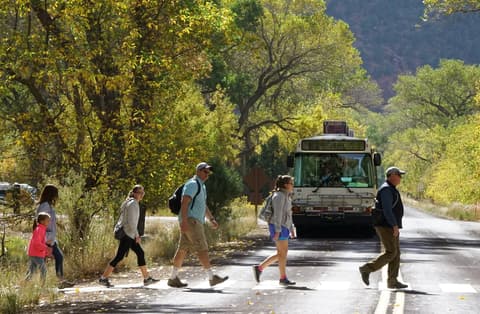
A group trip to Zion rarely means everyone wants the same day. One person wants Angels Landing and the chains. Another wants a bench, a view, and nothing near an edge. Neither one is wrong. Forcing a single itinerary onto six or eight people with different fitness levels usually backfires. Someone ends up pushed past their comfort zone. Someone else spends the day held back from what they actually came for.
The Real Problem, and How to Split Without Guilt
Most trip-planning advice assumes a group moves as one unit from trailhead to trailhead. Zion makes that assumption easy to break. The canyon shuttle runs a fixed loop with nine stops. Anyone can step off at any stop. Anyone can reboard later without waiting on the rest of the group. That single fact should change how a group day gets planned. Instead of picking one hike everyone can survive, split the group by what each person actually wants. Then pick a stop and a time to meet back up.
The mistake most groups make is negotiating a single plan that satisfies everyone a little. A cleaner split satisfies everyone a lot. A moderate hike that bores the strong hikers and exhausts the weaker ones serves nobody well. It just spreads the disappointment evenly instead of eliminating it.
Groups with a wide fitness range do best when the split happens before anyone leaves the hotel. It should not turn into a negotiation at the trailhead. Decide the night before who is doing the ambitious hike and who is doing something shorter. Treat both choices as equally valid parts of the same trip, not a consolation prize for whoever stayed behind.
For the ambitious half, Angels Landing is the obvious draw. It requires a permit through a seasonal lottery system now, not a walk-up ticket. That piece of planning has to happen weeks or months ahead of the trip. The lottery opens in four separate windows tied to hike date. A group aiming for a fall visit needs to apply back in the summer, not the week before. A day-before lottery exists too, open from just after midnight until 3 PM Mountain Time. It is a real gamble, though, for a group that built a whole day around getting the permit.
For a quieter alternative with a comparable payoff and no permit required, Observation Point delivers a higher vantage over the same canyon. It skips the exposed chains section entirely. Anyone nervous about heights but still fit enough for a real climb should consider this the default pick over Angels Landing, permit or no permit.
For the half that wants scenery without exposure, the Riverside Walk at Temple of Sinawava is paved and flat. It ends at the mouth of The Narrows, so it still delivers a real payoff. The Emerald Pools Trail gives that same group a slightly more active option. The lower pool is reachable by almost anyone, including kids and grandparents who skip the rest of the trail entirely. The upper pools add real elevation gain for those who want a bit more without committing to a full-day hike.
Making the Regroup Actually Work
The shuttle is what makes splitting up practical instead of stressful. Pick a specific stop and a specific time window. A vague plan to "meet up later" falls apart fast in a canyon this size. The Zion Lodge stop works well as a midpoint. It has restrooms, shade, and food options, and it sits roughly in the middle of the canyon route.
Cell service inside Zion Canyon is unreliable at best and absent at most trailheads. A plan that depends on texting to coordinate will fail at the worst possible moment. Agree on a stop and a time before anyone splits off. Build in a 30-minute buffer, since hikes rarely finish exactly on schedule. That matters most for a permit-holder group timing an Angels Landing entry window against a strict start time.
A short list covers what actually needs deciding before the group splits:
- Which hike each subgroup is doing, decided the night before, not at the trailhead.
- A specific shuttle stop and time window for regrouping, with a buffer built in.
- Who is checking the weather and flash flood risk that morning, since one person should own this for the whole group.
- A backup plan if someone's hike runs long, since waiting at the wrong stop wastes everyone's afternoon.
A group of six arrives at the Grotto stop by 7:30 AM. Two hikers with an Angels Landing permit head up immediately. The trail takes three to five hours round trip, and mornings avoid both the worst heat and the biggest crowds at the chains. The other four ride the shuttle to Zion Lodge. They walk to the Lower Emerald Pool, then continue on to Temple of Sinawava for the Riverside Walk.
Both groups plan to meet back at Zion Lodge by 1:00 PM. The Angels Landing hikers arrive first and grab a table. The other four roll in twenty minutes later, well within the buffer everyone agreed on that morning. Nobody spent the day arguing about pace, and nobody skipped the hike they actually wanted.
Budgets, Meals, and When to Stay Together
Fitness is not the only thing that splits a group. Budget does too, and pretending otherwise creates its own quiet tension. Some travelers want a sit-down dinner in Springdale every night. Others are happy with sandwiches eaten on a shuttle bench. Neither preference needs to win for the whole group. Pick one shared dinner for the trip, then let breakfast and lunch stay flexible for whoever wants to spend differently. Groceries in Springdale run limited and pricier than a real supermarket, so a Costco or Smith's run in St. George or Hurricane on the way in saves money for the whole trip, not just one meal.
Large groups booking lodging together run into a related problem. Springdale fills up fast in peak season, and one property rarely has enough rooms or cabins for six or eight people at once. Booking two or three nearby properties instead of holding out for one that fits everyone usually saves real money and real stress.
Splitting up is not the answer to every part of the day. Sunrise or sunset at a viewpoint works for almost any fitness level. It is worth doing as a full group, since the payoff has nothing to do with hiking difficulty. Dinner in Springdale after a long day apart is another natural point to reconvene. It gives the group something to talk about besides who did the harder hike.
Groups traveling in the shoulder seasons get an extra advantage here. Shorter lines at popular trailheads and a canyon that has not filled up by mid-morning make it easier for both subgroups to enjoy their choice. Nobody stands in a crowd waiting for a turn that should have taken five minutes.
The goal of a group trip to Zion is not making everyone do the same hike. It is making sure everyone comes home glad they went. Sometimes that means spending the day on opposite ends of the same canyon, then meeting up for dinner with two very different stories to tell.