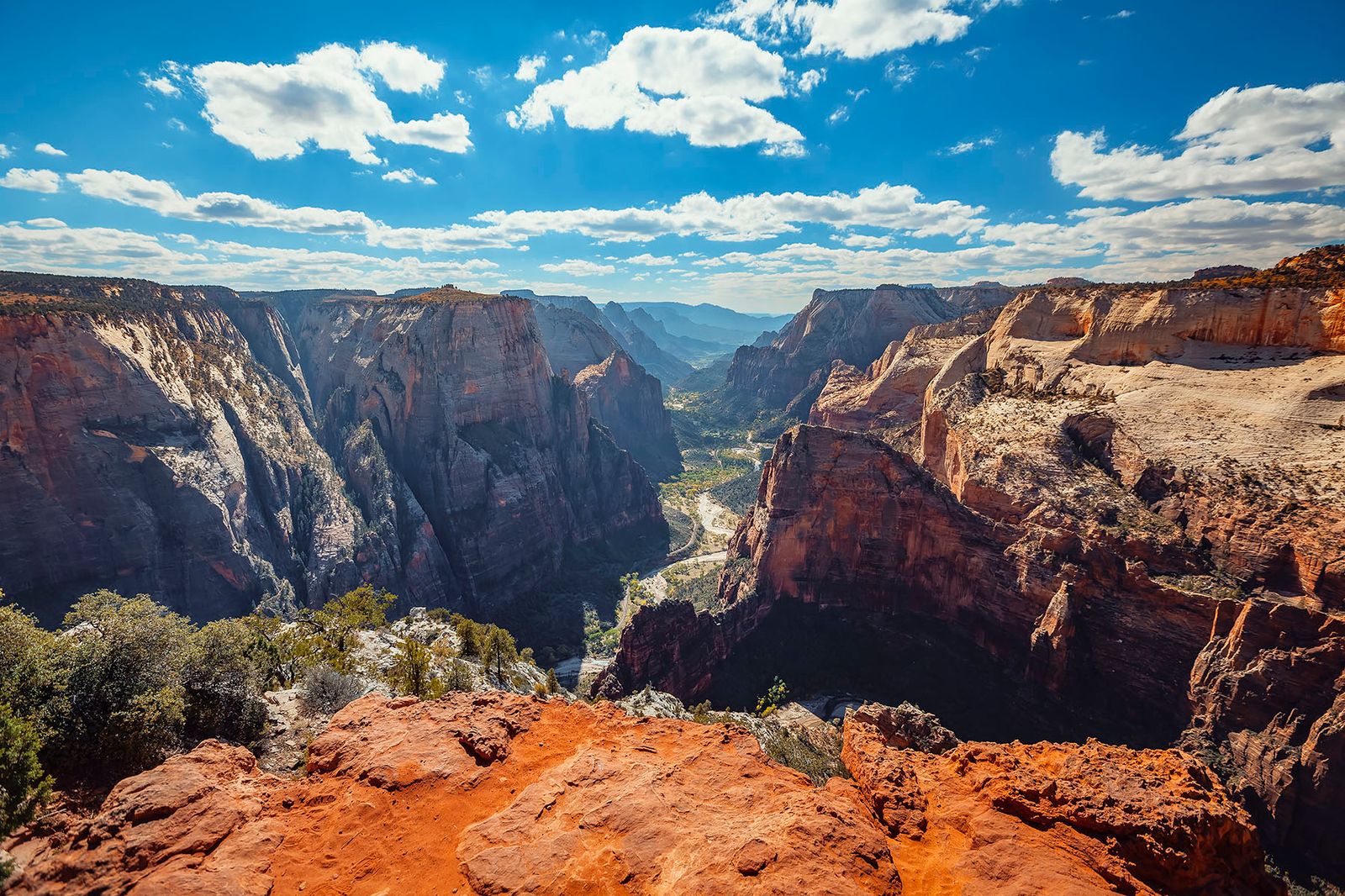
If you have ever stood on the summit of Angels Landing and looked directly across the canyon at the white sandstone point jutting out from the east rim, you were looking at the place that makes your hard-won view look like the opening act. Observation Point at Zion sits at 6,521 feet. Angels Landing tops out at 5,790. That is not a rounding error. It is 730 feet of vertical honesty about which viewpoint actually owns Zion Canyon.
The old trail from Weeping Rock, the one that switchbacked up the canyon wall through Echo Canyon and earned every bit of its reputation as one of the finest hikes in the national park system, is closed. It has been closed since a 31,292-ton slab broke off Cable Mountain in August 2019 and buried the route in rubble. The NPS lists it as a long-term closure, and geological surveys suggest the remaining rock face is not done moving. There is no reopening timeline.
But the viewpoint is still there. And the East Mesa Trail still reaches it, quietly, from the back door.
Distance: approximately 7 miles round trip
Elevation gain: 300 feet net (roughly 700 feet cumulative with the rim descent and return climb)
Time: 2.5 to 4 hours
Difficulty: Moderate (length and sun exposure, not steepness)
Permit: None required
Trailhead: East Mesa Trailhead, accessed via dirt road behind Zion Ponderosa Ranch Resort
Season: Approximately April through November (road conditions dictate the start and end)
The Hike Nobody Expects
Here is the thing about observation point zion that surprises people who hiked the old route or have only read about the strenuous 2,100-foot climb from Weeping Rock: the East Mesa approach is flat. Aggressively, almost suspiciously flat. You park on top of the plateau, walk a wide sandy jeep track through ponderosa pine forest for about three miles, and then the trees thin out, the ground drops away on your left, and suddenly you are standing on the edge of everything.
The first two miles feel like you are hiking in the wrong park. The trail winds through forest and meadow at 6,500 feet, with Gambel oak and ponderosa providing shade that the canyon floor hasn't seen since morning. You will pass the head of Mystery Canyon about two miles in, which is exactly the kind of place that makes you stop and stare straight down into a slot that technical canyoneers rappel through with permits and ropes. Do not attempt it. Keep walking.
Around mile three, the trail drops slightly and joins the old Observation Point Trail coming up from the canyon. This is the only section with real elevation change, and you will feel it more on the way back when the 200-foot climb catches legs that thought the hard part was over. The last half mile narrows to a ridge with scattered juniper and the canyon opening up on both sides. There are no chains, no cables, no exposure that would make anyone with a moderate fear of heights reconsider. You just walk to the edge and the entire canyon unrolls beneath you like a blueprint that got left out in the sun.
What You See That Angels Landing Cannot Show You
Angels Landing gives you an intimate view. You are inside the canyon, surrounded by walls, looking up at the formations. It is a view that earns its drama through proximity and adrenaline, and the chains and the drop-offs and the knowledge that people have died on that trail add a weight to every photograph you take there. If you are planning an Angels Landing trip, our trip planning guide covers the permit lottery step by step.
Observation Point gives you the director's cut. You are above the canyon, looking down on it. Angels Landing is directly below you, 730 feet lower, and the hikers on its summit look like ants on a fin of rock that suddenly seems a lot smaller than it felt when you were standing on it. The Great White Throne rises to the south at 6,744 feet, which means you are nearly eye-level with its summit instead of craning your neck from the canyon floor. Cable Mountain is to your east, its fresh rockfall scar still visible. The Virgin River threads the canyon floor like a vein in a wrist. Cathedral Mountain and the West Rim stretch out across the way.
The panorama is wider than anything Angels Landing offers because you are not in the canyon. You are above it. The trade-off is that you lose the visceral, I-might-die energy that makes Angels Landing famous. Observation Point does not care about your adrenaline. It cares about scale. And scale, for my money, ages better in a photograph.
Morning light between 8 and 10:30 is the sweet spot for photography. The canyon fills with warm side-light, Angels Landing catches sun on its western face, and the shadows give the whole scene enough depth to actually read as three-dimensional in a flat image. Midday washes it all out. Late afternoon throws warm light on the West Rim formations but means hiking back in fading light on an unlit dirt road, so bring a headlamp if you push it.
Getting There: The Part That Requires Actual Planning
The East Mesa Trailhead is not in Zion Canyon. It is not on the shuttle route. It is not even accessible through the main park. You reach it by driving east through the Zion-Mt. Carmel Tunnel and out the East Entrance, turning north on North Fork County Road, passing Zion Ponderosa Ranch Resort, and continuing on a dirt road for the last 2.5 to 3 miles. The drive from Springdale takes 45 minutes to an hour depending on tunnel traffic. Our Getting Around guide covers the shuttle and tunnel logistics if you need to plan that leg.
That last stretch of dirt road is where your planning either pays off or falls apart. When it is dry, most cars can handle it with patience and some tactical line-picking around the ruts. When it is wet (and in April, it is often wet), the road turns into the kind of slick clay situation that makes you question every decision you have made since renting a sedan at the Las Vegas airport. AllTrails reviews from December 2025 and January 2026 describe vehicles getting stuck, frozen ruts that melt into soup by mid-morning, and conditions that shut down even the shuttle service.
The shuttle is the move. East Zion Adventures runs a shuttle from Zion Ponderosa Ranch Resort to the trailhead for $7 per person round trip. You park for free at the resort, ride a high-clearance vehicle to the trail, and pick up the return shuttle at scheduled intervals on the quarter and three-quarter hour. The shuttle operates roughly March through November but does not run when the road is too muddy, so call ahead or check their site if you are planning a spring trip. Book in advance. The vehicles seat about 12 and walk-on spots are not guaranteed.
If you have a real 4WD vehicle (not an all-wheel-drive crossover, an actual truck or Jeep), you can drive yourself and park at the trailhead, which has room for about 15 vehicles. But check current conditions on AllTrails within 48 hours of your trip. The road can change overnight.
One more logistics note worth knowing: the trailhead has no water, no restrooms, and no services. Bring everything you need. Cell service is inconsistent between the resort and the rim, so download your trail map offline before you leave Springdale.
Why This Is the Best Second-Trip Hike at Zion
Most first-time Zion visitors stick to the canyon floor. Angels Landing, the Narrows, Emerald Pools. Those are the right calls for a first visit. They are accessible from the shuttle, well-marked, and deliver the Zion experience that every photograph and travel show has primed you to expect.
Observation Point is for the second visit, when you have done the greatest hits and want to see the park from a perspective that most visitors never reach. It requires more planning than anything on the shuttle route. You have to drive to the east side. You need to deal with a dirt road or book a shuttle. You are committing half a day when you factor in the drive, the hike, and the return. None of that is hard, exactly. It is just inconvenient enough that most people skip it.
That is precisely why the viewpoint is not crowded. On a day when Angels Landing's lottery has filled every permit slot and the Narrows looks like a parade, Observation Point might have 20 people on it. The quiet is part of the experience. No chains clanking, no nervous laughter from the exposure, no one squeezing past you on a narrow spine. Just canyon, sky, and the sound of wind through the junipers at the edge of a drop that would kill you just as dead as Angels Landing's but somehow feels less personal about it.
(One more thing for the people who lost the Angels Landing lottery and are looking for a consolation prize: Observation Point is not a consolation prize. It is a different experience entirely. The view is wider, the summit is higher, and you do not need anyone's permission to stand on it. The only thing it lacks is the fear, and for a lot of hikers, that is not a loss.)
Browse the hiking section on Zion Travel for trail conditions, route options, and more ways to get above the canyon floor.


