You are sitting at your laptop with 37 browser tabs open, and every one of them is telling you something different about Zion National Park. One says you need a permit. Another says the road is closed. A third is trying to sell you a $200 guided tour for a trail you can walk on your own.
Close the other tabs. You are in the right place.
This is the only page you need to read before you start planning a trip to Zion. It covers timing, transportation, reservations, fees, and the handful of decisions that shape whether your trip goes well or sideways. Where a topic goes deeper than a few paragraphs, you will find links to our full guides. Start here, branch out as needed.
When to Visit Zion and What Each Season Looks Like
The short answer: spring and fall are the sweet spot. The longer answer matters, because each season at Zion is a completely different trip.
March through May brings comfortable hiking temperatures, waterfalls running full from snowmelt, and wildflowers along the canyon floor. The Narrows typically opens as water levels drop in mid-June, though spring runoff can push that later. Crowds build through April and peak around Memorial Day. This is the season most first-timers should target if they want the full range of trails without the heat.
June through August is hot. Daytime temperatures in the canyon regularly hit 100 to 105 degrees, and exposed trails are dangerous by midday. Summer visitors should plan hikes before 9 AM and expect the shuttle lines to be at their longest. Afternoon thunderstorms bring flash flood risk to slot canyons and the Narrows. That said, summer is when the park runs the longest shuttle hours, and early mornings before the heat sets in are worth the alarm clock.
September through November is when locals will tell you to come. October in particular has warm days, cool mornings, fall color along the Virgin River, and far fewer people than summer. The shuttle keeps running through late November.
December through February is Zion's quiet season, and it is underrated. The shuttle stops running (except for a brief holiday window around Christmas), which means you drive your own vehicle through Zion Canyon. No shuttle lines. No fighting for a parking spot at 7 AM. Snow on the canyon rims against red rock is worth the cooler temperatures. The tradeoff: some trails may be icy, the Narrows is closed, and daylight hours are shorter.
For a month-by-month breakdown with trail conditions and crowd levels, check our seasonal guides in the Trip Planning section.
Getting There, Getting Around, and What It Costs
Getting to Zion is straightforward from two directions. The park sits about 2.5 hours northeast of Las Vegas and about 4.5 hours south of Salt Lake City, both via I-15. Most visitors fly into Las Vegas, rent a car, and drive up through St. George and Hurricane to the park's South Entrance in Springdale. A new SunTran bus route from St. George launched in early 2026 with $5 one-way fares if you would rather not drive.
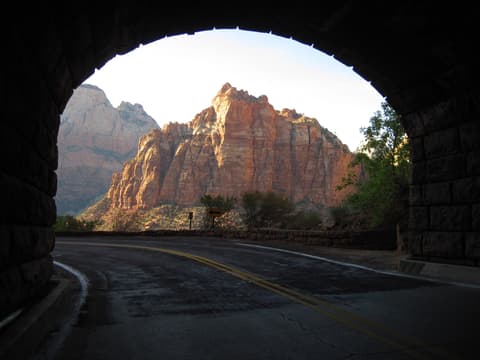
If you are coming from Bryce Canyon or the east side of the park, you enter through the East Entrance on Highway 9. The route includes the famous Zion-Mt. Carmel Tunnel, and the rules are changing in 2026. Starting June 7, the park will no longer allow vehicles that exceed specific size and weight limits on the Zion-Mt. Carmel Highway between Canyon Junction and the East Entrance. The tunnel escort for oversized vehicles is going away entirely. If you are driving an RV or towing a trailer, check your dimensions on the NPS large vehicles page before you plan your route. Our transportation guide covers alternate routes.
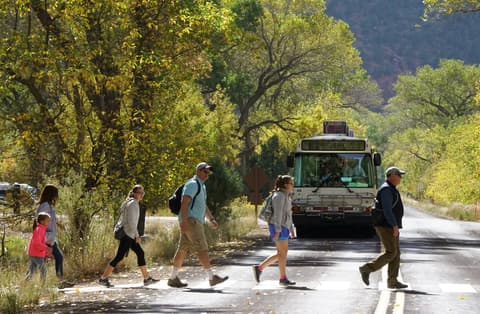
The shuttle system is how you access Zion Canyon during most of the year. Get this part right and your first day goes smoothly. Get it wrong and you lose two hours before you set foot on a trail.
From early March through late November, private vehicles are not allowed on the Zion Canyon Scenic Drive. You park at the Visitor Center or in Springdale and ride the free park shuttle. The 2026 season began March 7 and runs through November 28, with brief holiday service December 26 through January 2. No tickets, no reservations, no cost beyond your park entrance fee. Shuttles run every 5 to 10 minutes in the canyon and every 10 to 15 minutes from Springdale.
Here is the part that catches people: parking at the Visitor Center fills between 8 and 9 AM almost every day of the year. Arrive at 9:30, and you will park in Springdale and take the town shuttle in. That is fine (the Springdale shuttle is also free), but it adds 20 to 30 minutes to your morning. New for 2026, a Park and Ride operates from the town of Virgin at Zion White Bison Resort. A $5 shuttle connects to Springdale, and it works well for visitors with larger vehicles who want to skip the parking scramble entirely.
During winter months when the shuttle is not running, you drive your own car through the canyon. (One of the real perks of a winter visit that most planning guides skip over.)
Entrance fees changed on January 1, 2026. For US residents, the standard fee is $35 per vehicle (covers up to 15 passengers for seven consecutive days), $30 per motorcycle, or $20 per person entering on foot or by bicycle. If you plan to visit two or more national parks within a year, the $80 America the Beautiful Annual Pass pays for itself after the second park.
For non-US residents, a $100 per person surcharge now applies to visitors age 16 and older at Zion and 10 other high-visitation parks. Children 15 and under are exempt. The $250 Non-Resident Annual Pass covers the surcharge for the pass holder and all passengers in one vehicle, which saves real money for families and groups visiting multiple parks. US permanent residents with a green card qualify for the standard domestic rates.
You can purchase passes digitally on Recreation.gov before your trip and store them on your phone. Bring a valid photo ID. Our entrance fees guide walks through which pass makes sense for different trip types.
Reservations, Permits, and What You Can Just Show Up For
This is the question that trips up most first-timers. The short version: most of Zion is first-come, first-served, but a few things require advance planning, and those few things have zero flexibility.
Angels Landing: permit required. If you want to hike the famous chain section from Scout Lookout to the summit, you need a permit. Required every day, all year, at all hours. The fine for hiking without one runs up to $5,000.
Permits come through a lottery on Recreation.gov. The seasonal lottery opens quarterly, two to five months before your hiking dates. You pick up to seven preferred dates and time slots, pay a $6 non-refundable application fee, and wait. If selected, you pay $3 per person. The day-before lottery opens at 12:01 AM Mountain Time and closes at 3 PM the day before your hike, with results by 4 PM. Both lotteries allow groups of up to six.
Your odds are better than the hype suggests. Roughly 47% of seasonal applicants won permits in 2024, and weekday dates in shoulder season have much less competition than summer weekends. Our full Angels Landing permit guide walks through the strategy step by step.
You can also hike to Scout Lookout without any permit. The views from that point are still outstanding, and a lot of experienced Zion hikers prefer it because you skip the chain-section crowds and the lottery stress entirely.
Camping: reservations strongly recommended. Watchman Campground takes reservations through Recreation.gov up to six months out, and popular spring and fall dates sell out quickly. South Campground is first-come, first-served and fills early in the morning during peak season. If campground dates look tight, our lodging guides cover options in Springdale, Hurricane, and Kanab, plus RV parks outside the park.
Zion Lodge: book well ahead. This is the only in-park lodging and it fills months in advance. If the lodge is full, Springdale is a five-minute drive from the entrance with options at most price points. Our lodging directory has the full rundown.
The Narrows: no permit for day hikes. You can hike up the Virgin River from the Temple of Sinawava without a permit. Check river conditions on the NPS website before you go. Flash flood potential closes the Narrows periodically, and the park posts daily flow rate updates. The top-down through-hike does require a wilderness permit. You will want canyoneering shoes and a hiking stick for any Narrows trip. You can rent both in Springdale.
The Subway: the bottom-up route currently does not require a permit. The top-down route requires a wilderness permit through the lottery system. Check the NPS permits page before your trip, because these rules can change between seasons.
Everything else in Zion is first-come, first-served with your park entrance fee. Canyon Overlook Trail, Watchman Trail, Pa'rus Trail, Emerald Pools, Riverside Walk, Observation Point (via the East Mesa Trail from the east side), and the entire Kolob Canyons section are all open without advance booking. That covers the vast majority of what most visitors want to do.
Three Mistakes That Wreck a First Zion Trip
Three mistakes account for most of the frustration first-timers run into at Zion.
Mistake 1: Arriving without understanding the shuttle. Every season, visitors show up expecting to drive to the trailheads and discover the Scenic Drive is closed to private vehicles. They did not budget time for the shuttle. They did not know parking fills early. They lose two hours on day one that they will not get back. Read the shuttle section above, arrive early, and plan your first hike from a shuttle stop rather than trying to figure out the system after you get there.
Mistake 2: Trying to do too much in one day. Zion Canyon is only about seven miles long, so it looks manageable on a map. But shuttle logistics, trail times, heat (especially in summer), and the reality that you are hiking at elevation in a desert canyon mean a three-trail day often turns into a two-trail day with a miserable third attempt. Pick two priorities per day. Finish the first well before starting the second. If you end a day with energy left, that is a good Zion day. Our itinerary guides lay out realistic day-by-day schedules for trips of one to five days if you want a structured plan.
Mistake 3: Not checking conditions before specific hikes. The Narrows closes when the Virgin River runs too high. Angels Landing closes for ice in winter or maintenance in spring. (Scheduled maintenance is planned for April 20 through 23, 2026.) Flash flood warnings shut down slot canyon access with almost no notice. Check the Zion alerts page at nps.gov/zion the morning of your hike, every time. Conditions change faster than the weather forecast.
A note on packing: you do not need specialized gear for most Zion trails. Trail runners work fine on maintained paths. What you do need is a refillable water bottle (at least 32 ounces, more in summer), sun protection, sturdy closed-toe shoes, and layers. The canyon is cooler than the rim, and temperatures swing 20 degrees between morning shade and afternoon sun. Water, shade strategy, and honest expectations about distance will serve you better than any gear list.
Start Planning
The details live in the guides linked throughout this page, and we keep them current as policies, fees, and conditions change.
If you are in the early stages, browse our Trip Planning section for deeper guides on permits, seasonal timing, entrance fees, and packing. If you already know when you are going and need to figure out what to do, start with our hiking and experiences directories. Either way, you are ahead of most visitors who show up with nothing but a vague plan and good intentions.
Frequently Asked Questions
How much does it cost to enter Zion National Park in 2026?
For US residents, the entrance fee is $35 per vehicle (covers up to 15 passengers for seven consecutive days), $30 per motorcycle, or $20 per person entering on foot or by bicycle. Non-US residents age 16 and older pay an additional $100 surcharge. The America the Beautiful Annual Pass is $80 for US residents.
Do you need a permit to hike Angels Landing?
Yes, you need a permit every day, all year. Permits come through a lottery on Recreation.gov with a $6 application fee. If selected, you pay $3 per person. Roughly 47% of seasonal applicants won permits in 2024, and you can also hike to Scout Lookout without a permit for outstanding views.
When is the best time to visit Zion?
Spring (March-May) and fall (September-November) are the sweet spot. October is especially ideal with warm days, cool mornings, fall color, and fewer crowds. Summer (June-August) reaches 100-105 degrees. Winter (December-February) is quieter with no shuttle service.
Can you drive your own car through Zion Canyon?
From early March through late November, private vehicles are not allowed on the Zion Canyon Scenic Drive. You must use the free park shuttle. In winter months when the shuttle is not running, you drive your own car through the canyon.
How far is Zion National Park from Las Vegas?
Zion sits about 2.5 hours northeast of Las Vegas via I-15. Most visitors fly into Las Vegas, rent a car, and drive through St. George and Hurricane to the park's South Entrance in Springdale.
What are the biggest mistakes first-time Zion visitors make?
The three most common mistakes are: arriving without understanding the shuttle system and losing time to parking, trying to do too much in one day instead of picking two priorities, and not checking daily conditions before hikes since the Narrows and Angels Landing close unpredictably.
Plan your budget: try our free Zion cost calculator — compare passes and see the 2026 $100 non-resident surcharge for your exact group.