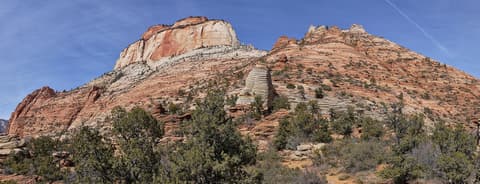
Dramatic red rock cliffs and sandstone formations of West Temple towers illuminated by golden sunlight in Zion National Park Utah
National ParkPopular

Zion National Park

Towering red rock canyons, narrow slot passages, and legendary trails create Utah's most dramatic outdoor playground

(47,804)
$$$$Springdale, UT

About

Zion National Park stands as one of America's most spectacular natural treasures, where massive sandstone cliffs rise thousands of feet above the Virgin River's winding canyon floor. This 229-square-mile wonderland in southwestern Utah draws millions of visitors annually to experience its otherworldly landscape of crimson towers, emerald pools, and narrow slot canyons carved by water and time.

The park's crown jewel, Zion Canyon, stretches 15 miles long and up to half a mile deep, accessible via the scenic drive that follows the Virgin River upstream. From April through October, the mandatory shuttle system transports visitors to nine stops along the canyon, each providing access to different trails and viewpoints. The most famous hikes include Angels Landing, a thrilling 5.4-mile round trip that culminates in a knife-edge ridge with chains for support and 360-degree views, and The Narrows, where hikers wade upstream through the Virgin River between towering canyon walls that narrow to just 20 feet apart in places.

Beyond the main canyon, the park offers diverse experiences for every fitness level and interest. The Emerald Pools trails provide family-friendly options leading to desert oases and waterfalls. Canyon Overlook delivers spectacular views with minimal effort. For those seeking solitude, the Kolob Canyons section in the northwest corner of the park features finger canyons and the world's largest freestanding arch. Canyoneering, rock climbing, and backpacking opportunities abound for adventurous souls, though permits are required for many activities.

Planning ahead is essential for a rewarding Zion experience. The park operates on a permit system for popular hikes like Angels Landing and The Subway, with lotteries held months in advance. Springdale, the gateway town at the park's south entrance, offers abundant lodging, dining, and outfitter services. The park itself features the historic Zion Lodge and two campgrounds that fill quickly during peak season. Entry costs $35 per vehicle and includes seven days of access, making it an exceptional value for one of nature's greatest spectacles.

How the Canyon Was Carved

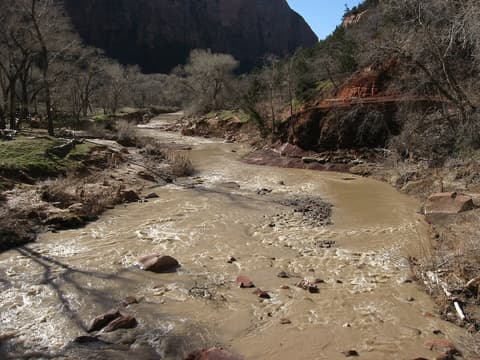
Zion Canyon's walls are Navajo Sandstone — ancient sand dunes, cemented into rock over millions of years, that once covered much of what's now the American Southwest. The Virgin River did the rest: as the Colorado Plateau slowly rose, the river cut down through that sandstone, carving a canyon that's now up to half a mile deep in places while staying narrow — in The Narrows, the walls close to as little as 20 feet apart. The river is still cutting today; a flash flood can move more sediment through the canyon in an hour than a normal year does, part of why canyon-bottom routes like The Narrows carry a real flood risk during monsoon season (July through September).

A Brief History of Zion

People have used this canyon for thousands of years. Nomadic groups moved through around 7,000 years ago, and by roughly AD 1100 the Virgin Branch Puebloan and Fremont peoples had settled here before Southern Paiute tribes moved in as they migrated out. The Southern Paiute called the canyon Mukuntuweap, "straight canyon." Mormon pioneers arriving in the late 1800s renamed it Zion, from the ancient Hebrew word for "sanctuary" or "refuge."

Protection came in stages. President Taft established Mukuntuweap National Monument on July 31, 1909. It became Zion National Monument in 1918, then was renamed and established as Zion National Park in 1919. A second monument — what's now the Kolob Canyons section — was set aside separately in 1937, and folded into Zion in 1956.

What to See at Zion National Park

Zion Canyon runs 15 miles long and reaches up to half a mile deep, cut by the Virgin River through the Navajo Sandstone. The canyon's signature character comes from the relationship between the vertical walls — which in places rise thousands of feet — and the river and vegetation on the canyon floor below. Beyond the main canyon, Zion contains distinctly different sections: the Kolob Terrace, a high plateau reached by Kolob Terrace Road from the town of Virgin, sits roughly 3,000 feet above the canyon floor and offers hiking through pine forests and open meadows with completely different terrain and temperatures. The Kolob Canyons section, accessed from the northwest, features narrow finger canyons and the park's largest freestanding arch. Wildlife is present throughout the park; observe from a distance and do not approach animals.

Getting to Zion National Park

Zion sits in southwestern Utah, off Highway 9 near the town of Springdale. The closest major airport is Las Vegas (LAS), about 160 miles and just under 3 hours by car via I-15. St. George Regional Airport (SGU) is closer, about 45 miles, but has more limited commercial service. From Salt Lake City, it's roughly 300 miles, about 4.5 hours via I-15.

Visitor Tips

  • Summer heat in Zion Canyon can be severe, especially on exposed trails and in canyon bottoms where heat radiates off sandstone walls; mid-day conditions in June through August can become dangerous. An early morning start and a mid-day rest during summer are strongly recommended.
  • Afternoon thunderstorms are possible from July through September during monsoon season; canyon bottoms and any route that involves wading are vulnerable to flash flooding from storms that may be miles away and not visible from where you are standing.
  • Cell service is limited or absent throughout much of the park — download offline maps, check trail conditions at the visitor center in person, and let someone know your planned route and expected return time.
  • The Kolob Terrace and Kolob Canyons sections of the park offer a very different experience from the main canyon — less crowded and with different terrain — and are worth considering if the main canyon shuttle and trails are at capacity.

Planning Your Visit

Zion Canyon Scenic Drive is served by the mandatory shuttle system during the operating season, typically March through November. Private vehicles are not permitted on the scenic drive during shuttle season; board at the Zion Canyon Visitor Center to access the canyon's nine shuttle stops. The visitor center area has restrooms, exhibits, and ranger information. Two campgrounds in the park fill quickly during peak season and often require advance reservations. Springdale, immediately outside the south entrance, provides lodging, dining, and outfitter services. Cell service is limited throughout much of the park, including many trailhead and canyon bottom areas. Check nps.gov/zion for current shuttle schedules, campground availability, and any access updates before your visit.

Park Amenities

Pet Friendly
Free Parking
Accepts Credit Cards

Frequently Asked Questions

How much does it cost to enter Zion National Park?

$35 per vehicle or $20 per person on foot or bicycle, valid for 1-7 days. Non-US residents age 16 and older pay an additional $100 surcharge unless they hold an Annual or America the Beautiful Pass.

Do you need a permit for Angels Landing?

Yes. The final chained section requires a permit obtained through a lottery system on recreation.gov — check NPS.gov for the current seasonal and day-before lottery windows, since the exact process has changed over time.

Is the Zion shuttle mandatory?

During the main operating season (typically March through November), yes — private vehicles aren't allowed on Zion Canyon Scenic Drive. Board the shuttle at the Zion Canyon Visitor Center to reach the canyon's nine stops.

How many days do you need at Zion National Park?

One full day covers the main canyon's highlights via the shuttle. Two to three days lets you add a permitted hike like Angels Landing or The Narrows, plus time in the Kolob Terrace or Kolob Canyons sections, which see far fewer visitors.

What is Zion National Park known for?

A deep, narrow sandstone canyon carved by the Virgin River — most famously Angels Landing's chained ridge climb and The Narrows, where hikers wade upstream between walls that close to 20 feet apart.

Is Zion or Bryce Canyon better?

They're different enough that most visitors pair them rather than choose. Zion is a deep sandstone canyon with a river running through it; Bryce is a rim-top amphitheater of hoodoos at nearly twice Zion's elevation. The two parks are about 85 miles apart, an easy add-on to either trip.

Reviews (47,804)

See all on Google
4.8

47,804 reviews

Write a review
Cadneod
Cadneod

3 months ago

Zion National Park completely lived up to the hype and ended up being one of the most unforgettable places I’ve ever visited. The moment you enter the park, the scenery feels unreal—massive red rock cliffs, huge canyon walls, and landscapes that look different around every turn. One of the best parts of visiting Zion was how much there is to experience beyond just the views. Whether you’re hiking, taking photos, riding the shuttle, or simply stopping to enjoy the scenery, every area feels unique. Even short walks have incredible viewpoints, and the scale of the cliffs makes everything feel much bigger in person than in pictures. What really stood out was how peaceful and immersive the park felt. There were moments where everything became quiet except for nature around you, which made the experience feel even more memorable. The changing light throughout the day made the colors of the canyon look completely different depending on the time. The park itself was well organized, with helpful shuttle access and trails that let you experience different parts of the landscape. It felt easy to enjoy whether spending a few hours or a full day exploring. Overall, Zion National Park is one of those places that’s hard to fully appreciate until you see it in person. The views are incredible, the atmosphere is unforgettable, and it’s the kind of place that makes you want to come back again someday. Definitely one of my favorite travel experiences.

Gavin Broom
Gavin Broom

2 months ago

I am in awe of Zion National Park! The beauty of the park cannot be described in words, and pictures do not justice. I was only there for a few hours, and I only did the hikes at stops 7 and 5, but I was not disappointed at all. I hope to go back to this stunning park one day. This is one of my most favorite National Parks ever!! My best advice is to get there early (we got there around 6:30), and make sure to bring plenty of water as well as comfortable walking shoes!!

Sia HM
Sia HM

2 months ago

One of the best national parks we have ever visited. We enjoyed Zion so much that we extended our stay by another week—the original plan was to spend only two days there. If you enjoy hiking and camping, this place is fantastic. The main downside is the morning traffic inside the park, particularly when trying to find a parking space. The shuttle service makes getting around much easier once you have parked, although we still waited about an hour in the queue. For summer visitors, I recommend visiting in the late afternoon, around two to three hours before sunset. The temperature is more comfortable, parking is usually easier, and there is still enough time to enjoy at least one of the shorter hikes. When we visited, entry was also free in the late afternoon. The only issue with arriving late is that you need to collect all the necessary information beforehand or visit the visitor centre shortly before it closes, which I believe is around 7:00pm during the summer. It is therefore a good idea to check the routes, shuttle times and closing hours in advance. Also have plenty of water in your car and with you 😅 Overall, it is an unforgettable national park and somewhere we would happily visit again.

Claire WithLove
Claire WithLove

4 months ago

After Capitol Reef's stunning colored, sculpted mountains and Bryce Canyon's hoodoo amphitheater, Zion offer s soaring mountains on each side of you, river, and many more non-hiker friendly trails besides the deadly Angel's Landing. It is an exceptionally well designed park with the free town and park shuttle system that centers at the Visitor Center and has many paved trails. - As you drive into Zion, you will go through the Zion-Mt Carmel tunnel - a 1.1 mile pitch black dark tunnel with no lighting, just a few windows of the stunning mountains as you drive through - The park and shuttles are free! Stay in Springdale for the closest location. The Best Western was very nice and Shuttle stop 4 - Favorite easy trails in my order of preference: -- Riverside Walk (2.2 miles, 57 ft elevation change, 1.5 hours) - paved path along the Virgin River in a Canyon -- Pa'rus Trail (1.7 or 3.5 miles, 50 ft elevation change, 1-2 hours) - start at park shuttle stop #3 (Canyon Junction-shuttle only stops going downhill - Not from the Visitor Center) for a 1.7 mile walk on a paved trail near the Human History museum, past the campgrounds and to the visitor center. If you start at the Visitor Center, then you will have to turnaround at Canyon Junction and it is 3.5 miles. - The Grotto Trail (1 miles, 35 ft, 0.5 hour) - dirt trail paralleling the road from Stop 6 (Grotto) to Stop 5 (Zion lodge) - saw and heard a wild turkey. - Weeping Rock Trail (0.4 miles, 98 ft, 0.5 hour) - short but steep paved trail ends at a rock alcove with dripping water - Lower Emerald Pool (2 miles, 150 ft, 1.5 hours) - paved trail to a small pool. It had been dry, so it was underwhelming but if it had rained more, it might have been better. If you are adventurous and like a good view and danger, then try to get a permit to hike Angel's Landing. Someone died the week before we arrived. In the park, there are 9 shuttle stops where you can get off to hike. The following stops have toilets (may be a pit toilet or flush toilet): stop 1 Visitor center - flush, 2 Zion Human History Museum - flush - but you have to walk a bit to get to the museum where the toilet are located outside, 5 Zion Lodge - flush -inside the lodge, 6 Grotto-pit?, 7 Weeping Rock-pit?, 9 Temple of Sinawava - pit.

Bahati Banks
Bahati Banks

a month ago

Just visited with my husband on a cross country road trip and had a wonderful time. Best hiking I’ve ever had with truly majestic mountain views. We parked in the park and took the free shuttle to access 3 trails. Highly recommended!!!!

Powered by Google

Nearby

Angels Landing
Featured
Zion National Park

Angels Landing

A legendary summit climb with chains, steep drop-offs, and breathtaking 360-degree views

(1,037)
The Narrows
Featured
Zion National Park

The Narrows

A breathtaking river hike through towering slot canyon walls

(750)
$$$$
Big Springs
Springdale

Big Springs

Crystal-clear spring waters mark the scenic turnaround point for upstream Narrows hikers

(21)
$$$$
Canyon Junction Bridge
Hurricane

Canyon Junction Bridge

Scenic viewpoint for sunrise and sunset photography over dramatic canyon landscapes

(304)
$$$$
Canyon Overlook Trail
Zion National Park

Canyon Overlook Trail

A scenic half-mile walk with sweeping views of Zion Canyon and the Virgin River.

(0)
$$$$
Emerald Pools Trail
Zion National Park

Emerald Pools Trail

Scenic trail system ascending through three tiers of natural pools and seasonal waterfalls

(412)
$$$$